Openings
Old Faithful (11-15)
Ink’s most trusted first move, heading for the centre. The old books and Checky both rate it the best. Here’s every sound reply, the line Checky teaches for each, and where it goes wrong.
Short answer
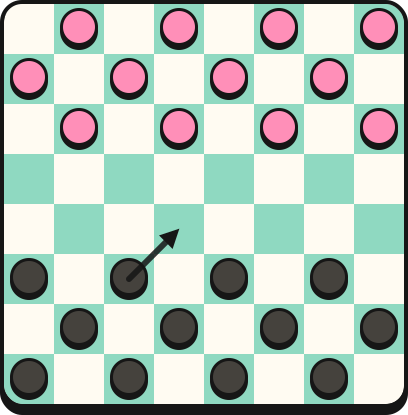
Old Faithful is the first move 11-15: Ink moves the man on 11 to 15. Pink’s sound replies are 22-17 (Dyke), 23-19 (Orthodox), 23-18 (Cross), 21-17 (Switcher), 22-18 (Single Corner), 24-20 (Ayrshire Lassie), 24-19 (Second Double Corner). Their lines have 4 traps worth knowing, below.
The first move
Written 11-15, it means Ink moves the man on square 11 to square 15. Pink has 7 sound replies, and each one leads to openings of its own. Below is each reply, the line Checky teaches for it, and the traps to watch for.
22-17: the Dyke
Pink stays out of the centre for now. Ink has a real choice here: the calm 8-11, or 15-19, which forces the action.
The main line Checky teaches: 11-15 22-17 8-11 25-22 11-16 17-13 16-20 23-18 7-11.
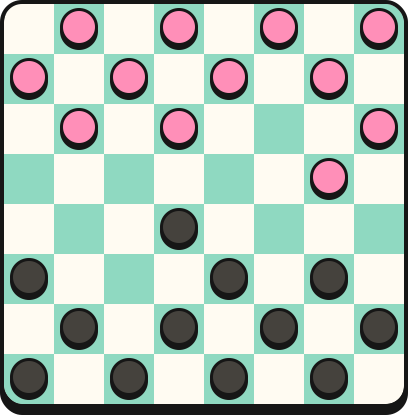
Named openings after 11-15 22-17
- Black Dyke 11-15 22-17 15-19. Ink pushes straight into Pink’s men. Two quick swaps follow, leaving an Ink man planted on 19.
- Boston 11-15 22-17 9-13 17-14 10x17 21x14. One of the oldest openings of all, found in William Payne’s book of 1756. It only got the name Boston in 1881.
- Wagram 11-15 22-17 9-13 24-20 13x22 25x18x11. Named after one of Napoleon’s battles. Once Pink plays 24-20 the jumps are forced, and the book finish is 8x15.
- Douglas 11-15 22-17 8-11 17-13 4-8 25-22. A rare road, also known as the Lady of Lorna.
- Maid of the Mill 11-15 22-17 8-11 17-13 15-18 23x14. Ink offers the man on 18 and Pink has to take it. Ink’s 9x18 takes back straight away, so it’s a quick swap.
- White Dyke 11-15 22-17 8-11 17-14. Pink pushes a man to 14 and Ink has to take. Both ways of taking hold up.
- Pioneer 11-15 22-17 8-11 25-22 11-16. A busy junction: plenty of other move orders end up in this same position.
- Wellington 11-15 22-17 15-18. Ink plays 15-18 straight away. Pink has to take with 23x14, and 9x18 takes back, so it’s an instant swap.
Trap: Ink’s 5-9
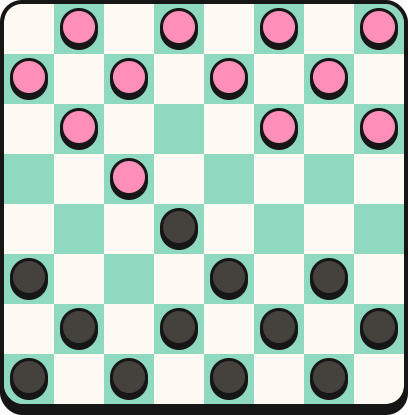
After 11-15 22-17 8-11 17-13 15-18 23x14 9x18 26-23, Ink’s 5-9 looks natural, but it loses two men to 23x14x5. You play Pink here: find the punishment.
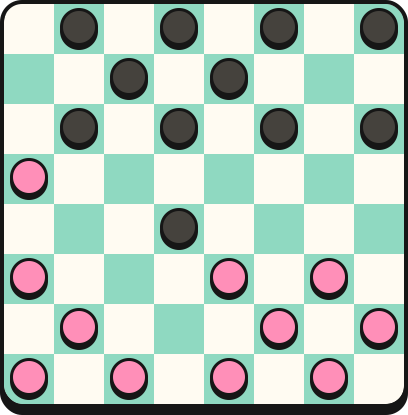 Learn this opening in Checky
23-19: the Orthodox
Pink puts a man in the centre, right up against Ink’s. Ink’s two main book answers are 8-11 and 9-14.
The main line Checky teaches: 11-15 23-19 8-11 22-17 3-8 25-22 9-14 29-25 11-16.
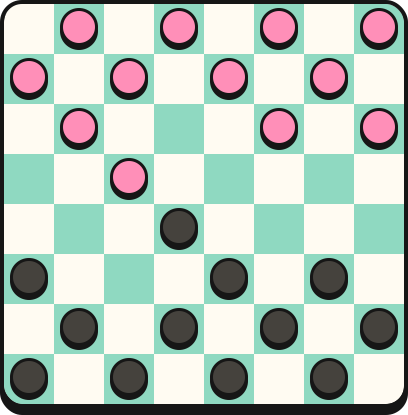
Named openings after 11-15 23-19
- City Game 11-15 23-19 8-11 22-17. A great crossroads. Four classic roads start here: the Glasgow, Laird and Lady, Old Fourteenth and Alma.
- Glasgow 11-15 23-19 8-11 22-17 11-16. After 11-16 and 24-20 a long run of jumps follows. Three men each come off, opening up the middle.
- Laird and Lady 11-15 23-19 8-11 22-17 9-13 17-14 10x17 21x14. Named after a Laird and Lady Cather. After this swap Ink’s main move is 15-18, a man deep into Pink’s half.
- Laird and Lady Refused 11-15 23-19 8-11 22-17 9-13 25-22. A famous mistake. Pink ducks the swap with 25-22, and 5-9 wins for Ink. It was already known to lose in the 1890s.
- Black Doctor 11-15 23-19 8-11 22-17 9-13 17-14 10x17 19x10 7x14. A very old gambit. Pink goes a man down on purpose, but the game is closer than the count suggests.
- Old Fourteenth 11-15 23-19 8-11 22-17 4-8. Ink backs up the man on 11. One of the oldest roads on the map, it goes back to William Payne’s 1756 book.
- Alma 11-15 23-19 8-11 22-17 3-8. Named after a Crimean War battle. Unusually, Ink moves a back-row man, the one on 3.
- Centre 11-15 23-19 8-11 22-17 15-18. Ink goes straight through the middle. Pink’s 19-15 sets off a chain of jumps, and two men each come off.
- Nailor 11-15 23-19 8-11 26-23. Pink steps off the busy road to avoid the well-known lines. John Drummond named it in 1866.
- Tillicoultry 11-15 23-19 8-11 22-18 15x22. A late Single Corner that takes its name from a Scottish town. Pink has to take back with 25x18 here: 26x17 loses.
- Defiance 11-15 23-19 9-14 27-23. With 27-23 Pink dodges the best-known roads. Worked out for an 1847 match, it’s still the modern choice.
- Fife 11-15 23-19 9-14 22-17 5-9. Among the strongest classic openings, named after the Scottish county. James Wyllie played it in 1847.
- Souter 11-15 23-19 9-14 22-17 6-9. Ink plays 6-9, the move that defines this opening. It was first spelled Suter, and the spelling changed in 1881.
- Whilter 11-15 23-19 9-14 22-17 7-11. Ink’s third road here, next to the Fife and Souter. The name has been spelled at least nine different ways.
- Whilter Exchange 11-15 23-19 7-11 22-18 15x22. Ink plays an early 7-11, and Pink swaps a man off straight away.
- Glasgow-Whilter 11-15 23-19 8-11 22-17 9-14 25-22 11-16 26-23. A rare spot, named for the two better-known roads it sits between.
- Will-o’-the-Wisp 11-15 23-19 9-13. An old road that goes back to William Payne’s book. Pink’s main answer is 22-18, which swaps a man at once.
- Dodger 11-15 23-19 8-11 27-23. Willie Ryan’s way for Pink to step around the well-analysed roads, much as the Defiance does against 9-14.
- Buffalo 11-15 23-19 8-11 22-17 9-14. An old favourite that can run into the Glasgow or the Souter.
Trap: Pink’s 19-16
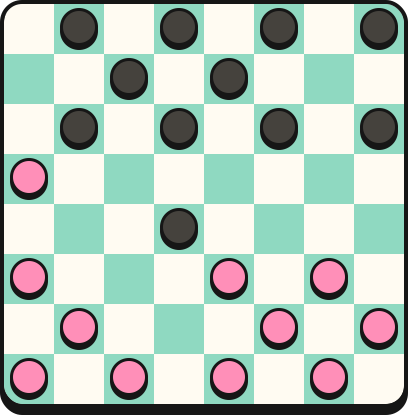
After 11-15 23-19 8-11 22-17 9-13, Pink’s 19-16 looks natural, but it loses a man to 13x22 26x17 12x19. You play Ink here: find the punishment.
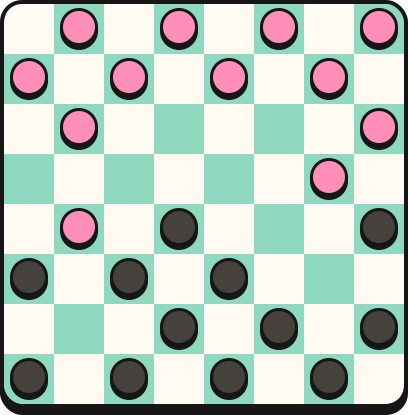 Learn this opening in Checky
23-18: the Cross
Pink steps across the path of Ink’s man on 15, which gives it its name. Ink’s main answer is 8-11.
The main line Checky teaches: 11-15 23-18 8-11 18-14 9x18 24-19 15x24 22x15x8 4x11 27x20 5-9.
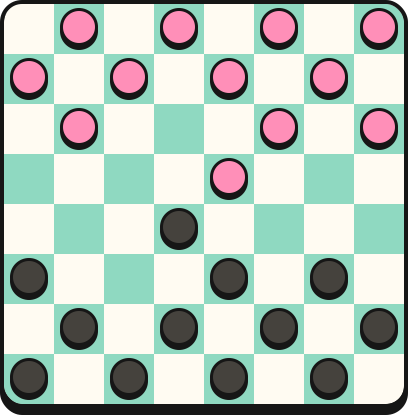
Named openings after 11-15 23-18
- Waterloo 11-15 23-18 8-11 18-14. Pink gives up a man with 18-14, then wins it back with 24-19 and a double jump.
- Crescent Cross 11-15 23-18 8-11 26-23. A very old road: James Wyllie played it against Andrew Anderson in 1844.
- Short Cross 11-15 23-18 8-11 27-23 10-14. One of the two most solid ways for Ink to avoid the main road of the Cross.
- Slip Cross 11-15 23-18 8-11 27-23 11-16. A tricky side road, first printed by Joshua Sturges in 1801. It has a well-known trap in it, so step carefully.
- Montrose Cross 11-15 23-18 15-19 24x15 10x19. Takes its name from another Scottish town, given in 1869. Ink swaps a man straight away with 15-19.
21-17: the Switcher
James Wyllie used this weak-looking move to confuse opponents. The strong reply is 9-13.
The main line Checky teaches: 11-15 21-17 9-13 25-21 5-9 23-18 12-16 18x11 8x15.
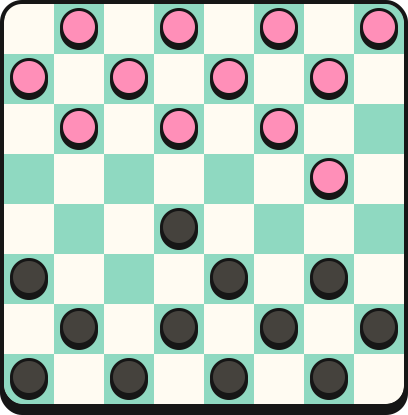
Trap: Pink’s 13-9
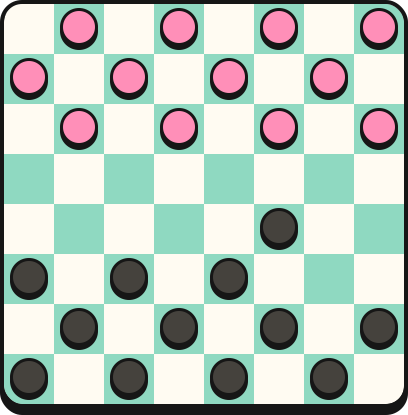
After 11-15 21-17 8-11 17-13 4-8 23-19 9-14, Pink’s 13-9 looks natural, but it loses a man to 6x13. You play Ink here: find the punishment.
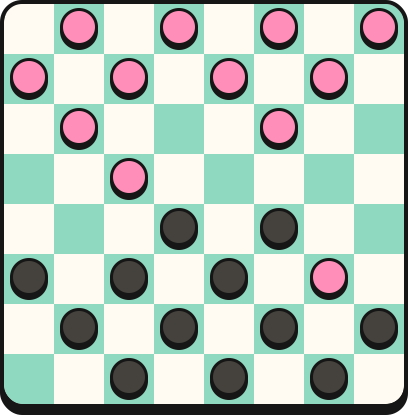 Learn this opening in Checky
Trap: Ink’s 12-16
After 11-15 21-17 9-13 23-18 5-9 18x11 8x15 27-23, Ink’s 12-16 looks natural, but it loses a man to 24-19 15x24 28x19x12. You play Pink here: find the punishment.
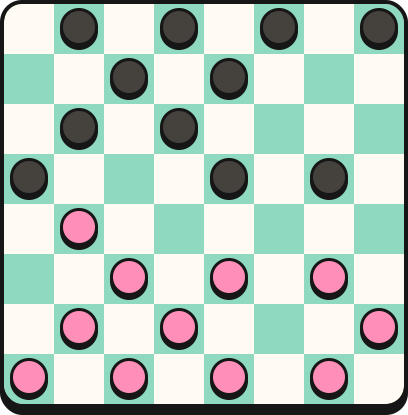 Learn this opening in Checky
22-18: the Single Corner
An early swap of one man each. Few openings have more written about them.
The main line Checky teaches: 11-15 22-18 15x22 25x18 12-16 24-19 16-20 29-25 8-11.
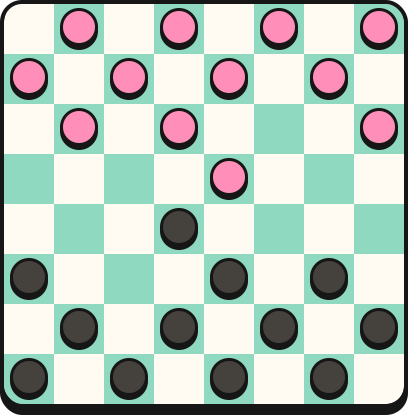
Named openings after 11-15 22-18
- 26-17 Single Corner 11-15 22-18 15x22 26x17. Pink takes back with the other man. It’s the rare way, and the weaker one: almost everyone prefers 25x18.
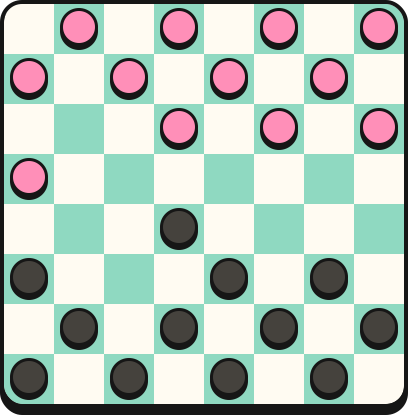
24-20: the Ayrshire Lassie
Pink heads for the side of the board. James Wyllie named this one after a young woman who loved to play it.
The main line Checky teaches: 11-15 24-20 8-11 28-24 4-8 22-18 15x22 25x18 10-15.
24-19: the Second Double Corner
Once called Wyllie’s Invincible, until it proved Pink’s weakest reply and got a humbler name.
The main line Checky teaches: 11-15 24-19 15x24 28x19 9-14 22-18 5-9 26-22 7-11.
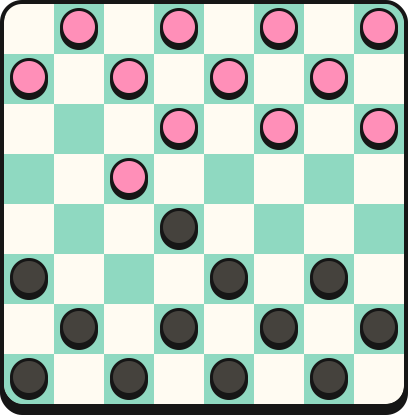
Named openings after 11-15 24-19
- 27-20 Second Double Corner 11-15 24-19 15x24 27x20. Pink takes back with the other man. It first came up in James Wyllie’s 1864 match with Robert Martins.
Learn the Old Faithful in Checky
Checky’s Openings teach the Old Faithful one line at a time: 29 lines for Ink across 7 replies, with a test at the end of each reply to check you know them. You can learn them as Pink too. Start learning openings.
Questions people ask
What is the Old Faithful in checkers?
It’s the first move 11-15, where Ink moves the man on 11 to 15. Ink’s most trusted first move, heading for the centre. The old books and Checky both rate it the best.
What can Pink play against 11-15?
Pink’s sound replies are 22-17 (Dyke), 23-19 (Orthodox), 23-18 (Cross), 21-17 (Switcher), 22-18 (Single Corner), 24-20 (Ayrshire Lassie), 24-19 (Second Double Corner). Each one is shown above with its main line.
How do I learn the Old Faithful?
Learn one reply at a time, starting with its main line. Checky’s Openings teach them move by move, then test you on them.